
This post contains affiliate links. View my full affiliate disclaimer here.
Having the ultimate summer homeschool schedule is easier than you think, and I’m going to share how to do it.
Many homeschoolers take a break from formal lessons during the summer months, which is fine. I get it! However, for my family, that’s not an option. I’ve tried it several times, and here’s what typically happens:
- The transition back to our homeschool schedule is derailed.
- My children experience the “summer slide.”
- My children suffer when their usual routine isn’t there.
- Laziness and boredom set in.
As my children get older, this may change. In fact, I’m sure it will, as I’ve seen the change in my oldest, who’s going on 16. But, for my younger two, ages 11 and 8, taking the summer off isn’t in the cards.
So, if you’re a homeschooler who wants to keep going with formal lessons while having a super fun summer at the same time, keep reading. I’ll help you have the ultimate summer homeschool schedule yet.
The ultimate summer homeschool schedule focuses on ensuring school work and fun are at the helm of your days, which is likely a change from your normal homeschooling schedule. (I’m the same way, don’t worry. We’re more bookwork heavy during the fall and winter while sprinkling in fun classes as we go.) However, for the summer, the goal should be to combine the two daily. It’s not as hard as you may think.
Summertime also offers a chance to slow down while maintaining a good pace with schoolwork and other fun learning experiences. But how does that look in real life? Here are my four hallmarks of having the ultimate homeschool summer schedule:

Keep lessons short and sweet.
If homeschooling usually lasts for hours, cut the time in half and then half again if needed. Summer school should be between 90 minutes to two hours. This limits how much is done and allows more time for doing other things.
Focus on 1-2 formal subjects a day.
Summer isn’t the time to jump into new or heavy material. Remember, the goal is to keep the formal lesson ball rolling without spending too much time on schoolwork.
I suggest sticking to subjects like math, language arts, or foreign language, which require repetition to retain what they’ve learned.
Do things you don’t normally do.
This is the time to do the things you keep putting off in favor of more formal learning. (I’m looking at you, science experiments, and arts and crafts!)
Having less formal subjects (and even outside classes) to cover leaves room to try the activities that are on your Pinterest boards and in the books on your bookshelves that you never get around to doing.
Participate in a daily challenge.
Summer offers a few months to build new habits and try different things without competing with the burden of many other school-related activities. Daily personal growth challenges are great for all ages/stages, including you, the homeschool parent. (Mmhmm. I’m looking at you, too!)
Small changes can lead to big changes, and adding them to your summer homeschool schedule is an easy way to get started.

Here’s our ultimate summer schedule to give a realistic idea of how I’m getting things done.
General Schedule
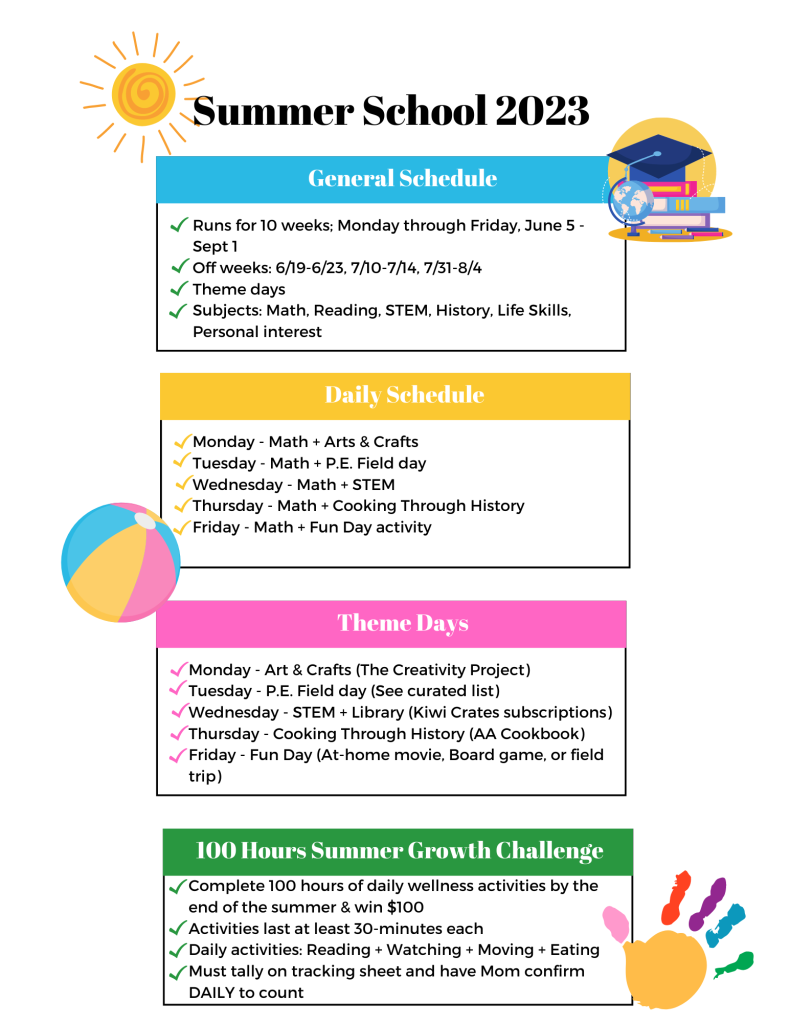
Our summer homeschool schedule runs for 10 weeks, Monday through Friday, from June 5th to September 1st. We have three weeks of designated off time for summer camps and vacations. I’ve developed themes for our days, which I’ll share in a second, and focus on one formal subject (Math from Learn Math Fast and Math Stickers) and a different activity-based experience that happens to cover other subjects.
Daily Schedule
We cover math and one other subject each day. Our daily schedule is as follows:
- Monday - Math + Arts & Crafts
- Tuesday - Math + P.E. Field Day
- Wednesday - Math + STEM
- Thursday - Math + Cooking through History
- Friday - Math + Fun Day Activity
Theme Days
Each day has its own activity theme. Here’s the breakdown:
- Monday - Arts & Crafts (I’m using guides from The Creativity Project (Save 50% of your first month using code HALFOFFCAMILLE at checkout,) YouTube, and Pinterest.)
- Tuesday - P.E. Field Day (I created a list of ideas. I’ll share it later in the post.)
- Wednesday - STEM (I got a three-month Kiwi Co. subscription for each child. Try it with your kids today.)
- Thursday - Cooking through History (I’m using An African-American Cookbook by Phoebe Bailey.)
- Friday - Fun Day Activity (We watch a movie at home, play a board game, or take a field trip.)
Personal Growth Challenge
I developed a personal growth challenge for my children that rolls like this:
- Complete 100 hours of daily wellness activities by the end of the summer and win $100
- Activities last at least 30-minutes each
- Daily activities are:
- Reading (No restrictions on what can be read or how it’s read, i.e., audiobook counts)
- Watching (Must be educational in nature - YouTube tutorials on gaming don’t count (Sorry, not sorry, kiddos))
- Moving (Must move their bodies to get the heart rate up and endorphins flowing)
- Eating (Make a healthy snack or meal for themselves or others)
I also created a daily wellness tracker to keep track of their hours. You can see what it looks like below.

Summer School Printouts
Here is what our schedule and tracker look like on paper. I printed out copies for each of us and put them inside a sheet protector to hang on hooks on the wall.
So, that’s how having the ultimate homeschool schedule is done, my friends. So far, this has been one of our best summers, meaning our time is balanced, and I’m not stressed out and doing too much. That’s always a win in my book.
Let me know what you think and if you decide to try this type of “summer school.” I’d love to know your thoughts in the comments below.
P.S. If you’re a new homeschooler who’s been at it for three years or less and want to learn how to have a relaxed yet productive upcoming homeschool year, check out my masterclass, Empowered Beginnings. I offer self-paced and live options to match your schedule and needs. Learn more here.
 The Intuitive Homeschooler